
Blog
Building Fair Pay in a Changing Market
Fair pay is no longer a static benchmark. It is evolving with the market, shaped by both corporate wage commitments and uneven regional growth. Recent headlines prove the point. Bank of America, for example, completed its $25 minimum wage pledge in 2025—a process phased in over several years from $15 in 2017. The move highlights how building fair pay is not an overnight fix but a long-term strategy to stay competitive.
Nationally, wage data shows broad but uneven shifts. 340 of the 372 largest U.S. counties saw weekly wages rise in early 2025. Nationally, average pay increased 4.1%. Yet salary growth is moderating, with most companies planning budgets of about 3.5% into 2026. For small businesses, wage growth has slowed further, holding below 3% for ten straight months.
Closer to home, wage data across the Kansas City metro tells a similar story. In the first quarter of 2025, Johnson County saw average weekly wages rise by 3.9% year-over-year, keeping it among the state’s leaders for income. Median household income there now sits above $107,000, well above state averages. Across the metro, Jackson County reports private-sector wages averaging $34.60 per hour, with a 4.3% annual increase in weekly pay. Clay County follows at about $30.34 per hour, reflecting a 1.9% gain over the same period.
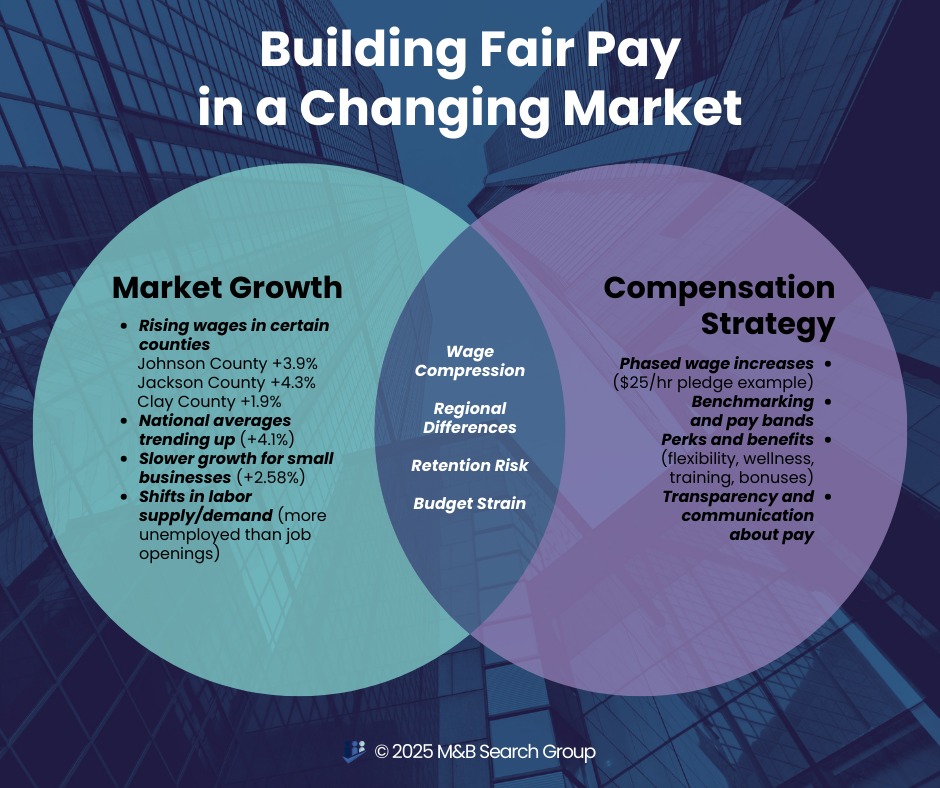
Taken together, these stories show how the evolving market and compensation strategy are relative to each other. As the market moves, pay strategies must move with it. Let’s dive into the challenges employers face and the practical ways to build fair pay in today’s environment.
Solving the Challenges of Building Fair Pay
Building fair pay is not without hurdles, but each challenge has a practical way forward:
- Wage Compression
As entry-level pay rises, the gap with mid-level roles narrows. This can frustrate experienced staff.
Solution: Adjust mid-level pay when possible and emphasize growth opportunities, skill-based bonuses, or career development to show added value.
- Regional Differences
What counts as fair in one region may fall short in another. A flat, national pay model often misses the mark.
Solution: Localize pay bands to reflect cost of living and labor market conditions, while maintaining consistency in company values.
- Retention Risks
Employees know their market value, and they notice when pay lags behind competitors.
Solution: Benchmark more often—quarterly instead of annually—and communicate openly about how pay decisions are made.
- Budget Strain
Rising wages can stretch budgets, especially in a cooling job market.
Solution: Plan ahead with phased adjustments. Balance direct pay increases with perks like flexibility, wellness benefits, and training that add real value without overwhelming costs.
Lessons from the Market
Fair pay is shifting under the weight of both market realities and corporate commitments. Employers who take a proactive, transparent, and flexible approach will be better positioned to attract, retain, and engage their people.
- Competitive compensation is a differentiator and a tool for building reputation, not just a cost
- Wage growth can outpace expectations in certain regions, requiring agile responses
- Pay raises are slowing overall, but targeted increases for high-value skills remain common, showing a recalibration rather than a retreat
In a changing market, fair pay is more than a paycheck. It is how companies prove they value their people and secure their future.
Like what you're reading?
Subscribe today for insightful posts delivered via email. We respect your privacy and won't spam your inbox.