
Blog
Rethinking What It Means to Dress for an Interview
For years, “dress for the job you want” was straightforward advice. A suit, polished shoes, and traditional business attire were often considered the safest choices for a professional interview. Today, the answer is less uniform.
Workplace dress codes have evolved alongside flexible work arrangements, changing company cultures, and greater emphasis on personal expression. Recent coverage of workplace dress codes notes that one-size-fits-all policies are becoming less effective as organizations seek to balance professional standards with employee autonomy and cultural alignment.
The shift is also reflected in how employees shop for and wear work clothing. Among more than 1,000 U.S. hybrid workers surveyed in the latest study, 92% said it was important for clothing to work in both professional and leisure settings. Twenty-five percent said their professionalism had been judged based on how they dress.
These findings, along with a recent poll we conducted through our M&B Search Group LinkedIn page, suggest that flexibility and professional perception now coexist. There’s a clear preference for business casual, while traditional business professional attire remains common. This does not mean every candidate needs a suit or that smart casual is always inappropriate. It does suggest that interview attire should be intentional, even as professional dress becomes more flexible. Employees may have more freedom in what they wear, but clothing can still influence how others perceive them.
Power dressing is no longer limited to a specific suit, heel height, or formal uniform. It means understanding the workplace, choosing clothing that helps you feel confident, and presenting yourself appropriately for the opportunity. The advice to “dress for the job you want” still applies, but it may be more useful to think of it as dressing with the job, workplace, and impression you want to make in mind.
Business Professional Means Different Things in Different Workplaces
One of the biggest challenges for candidates is that dress-code labels are not always interpreted consistently. “Business professional” and “business casual” can mean different things depending on the organization, industry, role, and even the person conducting the interview.
Appropriate attire depends on workplace culture and the nature of the work. Guidance on evolving dress codes illustrates that clothing suitable for a conservative financial organization may not be appropriate for a manufacturing production environment, and vice versa. The same principle applies to interviews. A candidate should consider not only how formal the organization is, but also what the role requires and where the interview will take place.
What Shapes Interview Attire Expectations?
- Industry and company culture: Traditional financial services firms may favor conservative tailoring, while technology or creative organizations may accept polished separates. These are general examples, not universal rules.
- Role and seniority: Executive, leadership, and client-facing roles may have different expectations than technical, operational, or entry-level positions. Seniority does not automatically require a suit.
- Interview setting: Boardroom interviews, video calls, facility tours, and hands-on assessments may each call for different practical considerations. For example, manufacturing candidates may need to follow safety requirements during a plant tour.
- Employer expectations: Organizations may interpret “business casual” differently. Asking for clarification is often more useful than relying on the label alone.
A Practical Guide to Common Dress Categories
| Dress category | General interpretation | Examples |
| Business professional | Traditional, structured professional attire | Coordinated suits, tailored dresses, dress shirts, professional footwear |
| Business casual | Professional clothing with less formality | Tailored trousers, khakis, blouses, button-downs, sweaters, blazers or polished separates |
| Smart casual | Elevated casual clothing that remains intentional and neat | Polished knitwear, khakis, structured jackets, and clean dark jeans where appropriate |
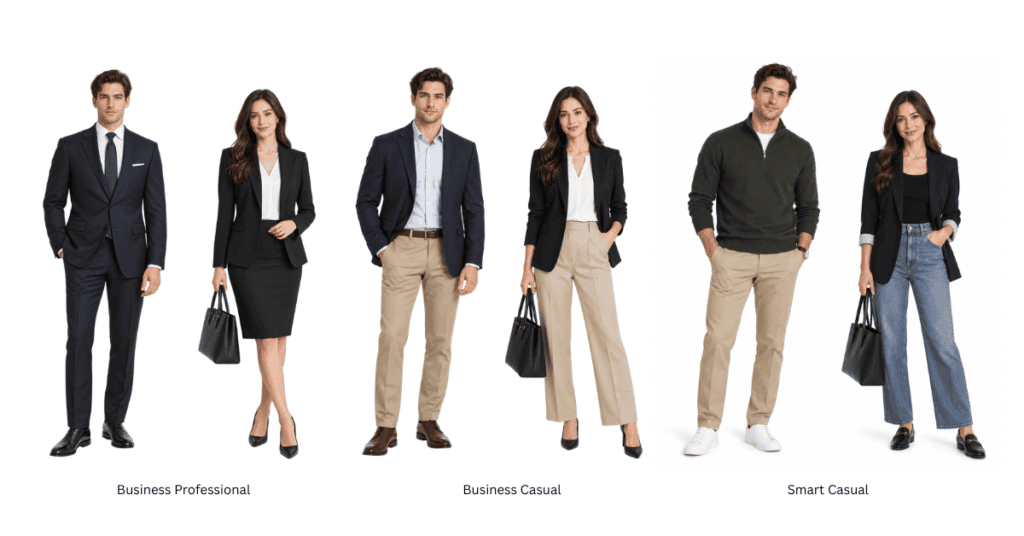
These categories can overlap, and employers may define them differently. Choose clothing that fits the work environment while also considering safety, accessibility, religious and cultural dress, and personal comfort.
A company’s everyday dress code does not always reflect what it expects from interview candidates. Employees may wear jeans and sneakers, while interviewers still expect candidates to dress more formally. However, dressing far above the expectations of the role can also create a mismatch. The goal is not to be the most formally dressed person in the room, but to show that you understand the professional environment you hope to join.
How to Dress for the Interview You’re Actually Attending
When interview dress codes are less defined, context matters. Before choosing what to wear, look at the company, the role, and the setting. A client-facing leadership interview may call for a different level of formality than a creative role, virtual interview, or facility tour.
Research the company’s website, LinkedIn presence, and employee photos for clues about its workplace culture. If you’re working with a recruiter, ask what the employer typically expects. This can be especially helpful when terms like “business casual” leave room for interpretation.
When specific guidance isn’t available, focus on a few fundamentals:
- Dress for the opportunity. Consider the role, industry, company culture, and interview setting.
- Aim for polished and intentional. Clean, well-fitting, comfortable clothing can make a stronger impression than simply choosing the most formal option.
- When in doubt, asking a recruiter or a hiring contact like M&B Search Group can help clarify expectations, especially for facility tours or workplaces with specific dress or safety requirements.
- Keep the focus on your qualifications. Your attire should support your professional presence, not distract from the experience and skills you bring to the conversation.
“Dress for the job you want” still has a place in today’s job search, but it comes with more context. The goal isn’t necessarily to be the most formally dressed person in the room. It’s to show that you understand the opportunity and are prepared for it.
Like what you're reading?
Subscribe today for insightful posts delivered via email. We respect your privacy and won't spam your inbox.