
Blog
Existing Gaps in Fair Workplaces
It’s football season in Kansas City, which means everyone’s talking about plays, stats, and wins. But this year, a different kind of number made headlines. A former Chiefs executive filed a lawsuit claiming he earned about $125,000—well below the $171,000 average for similar roles across the league. It’s not the usual game-day drama, but it sparked a question that reaches far beyond football: what happens when pay systems don’t keep up with the work?
That kind of gap isn’t unique to the NFL. It happens in offices, warehouses, and job sites every day. A finance manager who’s been quietly handling extra projects since the last reorg. A long-time employee who trains every new hire but earns less than the ones they onboard. A remote team member who performs just as well but gets overlooked in reviews. These are all signs of pay systems falling behind the pace of change.
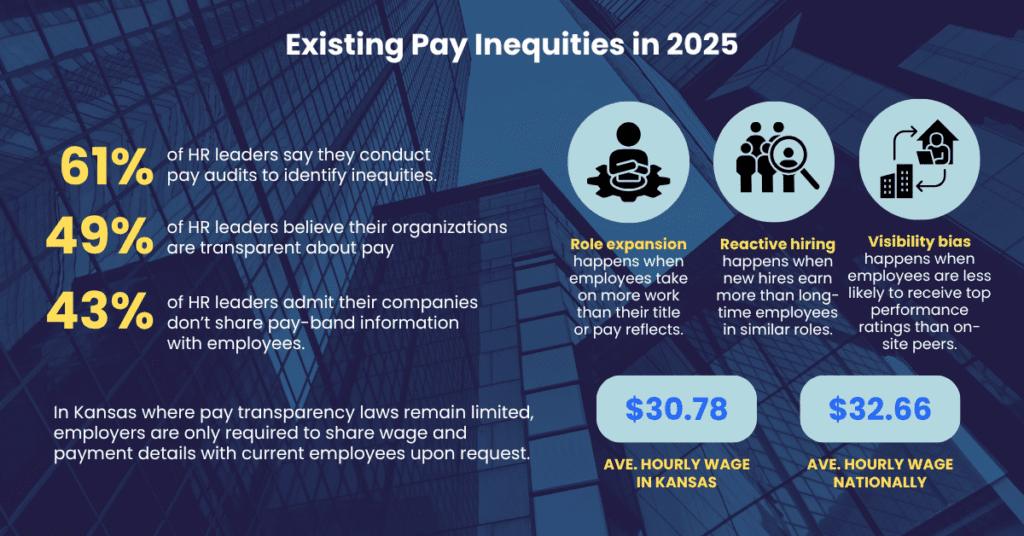
The irony is that many companies across the U.S. are trying to close these gaps but lack consistency. 61% of HR leaders say they conduct pay audits to identify inequities, yet only 54% do so annually. Even when transparency is encouraged, it isn’t applied uniformly—49% of HR leaders believe their organizations are transparent about pay, 34% disagree, and 43% admit their companies don’t share pay-band information with employees.
The topic is especially relevant in Kansas, where pay transparency laws remain limited. Employers are only required to share wage and payment details with current employees upon request. There’s no rule that salary ranges must appear in job postings, and applicants don’t have a guaranteed right to that information before they’re hired. Our average hourly wage in the Kansas City metro area, at $30.78, is still below the national average of $32.66. While it’s a small difference, it reflects how compensation often lags behind expectations—even in regions and industries that see themselves as fair and competitive. In a market where transparency depends on employer initiative, gaps in fair workplaces can easily emerge. Maintaining fair pay becomes a matter of consistency and trust—not compliance.
The Growing Gaps in Fair Workplaces
The pay gap today is less about intention and more about structure. Three patterns explain why it continues to happen: role expansion, reactive hiring, and visibility bias. Each shows how work has changed faster than the systems that support it. And while the causes differ, the result is the same—people doing more than they’re paid for, often without anyone realizing it.
- Role expansion happens when employees take on more work than their title or pay reflects. After several years of restructuring and lean staffing, many professionals now manage broader workloads without a change in compensation. “Role creep” is one of the fastest-growing causes of internal pay inequity. Employees aren’t being underpaid for what they were hired to do; they’re underpaid for how much their jobs have grown.
Bridge the Gap: Regularly reviewing job scopes during performance or merit cycles helps catch these changes early. It doesn’t require reclassifying every role—it simply means taking time to ask, “Has this position outgrown its pay range?” A quick adjustment now can prevent a quiet resignation later.
- Reactive hiring adds another layer to the problem. When the market heats up, companies often raise salaries to secure talent quickly. That might fill a seat fast, but it creates compression when new hires earn more than long-time employees in similar roles. Recent pay transparency studies found that new hires now earn 12 to 15 percent more than internal peers doing comparable work.
Bridge the Gap: Before opening a new position, some employers now run “pay previews” to see where internal salaries stand. If the market’s moved up, internal pay scales move with it. It’s a small shift that keeps new hires competitive and existing teams confident they’re valued just the same.
- Visibility bias is the most modern form of inequity. Hybrid and remote work have reshaped how performance is seen. Gartner’s 2025 HR Trends Report found that hybrid employees are 15 percent less likely to receive top performance ratings than on-site peers. The difference isn’t effort but exposure.
Bridge the Gap: Companies are rethinking how they measure success. Instead of relying on who’s seen most, they’re focusing on documented outcomes, clear metrics, and team-based recognition. When performance evaluations measure results instead of presence, the reward system finally matches the work being done.
The pay gap still exists because many organizations continue to face structural challenges in how compensation is managed. Inconsistent job leveling, reactive hiring practices, outdated pay bands, and performance systems that reward visibility over measurable value all create gaps between the work being done and the pay being given. These misalignments are often unintentional, but they carry real consequences for engagement, retention, and trust.
Keeping Workplaces Fair
Fairness starts with policy, but it’s proven in action. The way companies manage pay day to day shows what they truly value. Regular audits, open conversations, and consistent reviews help pay structures evolve with the business. Employees should see that their contributions matter regardless of race, age, and gender. When pay reflects that, people stay, perform, and trust the organization behind them. A fair pay system creates a fair workplace. Both are built on the same foundation—clarity, accountability, and respect for the people who make the work possible.
Even with progress, certain inequities persist. In Kansas, full-time women’s earnings are about 83 percent of men’s earnings, which sounds somehow unfortunate because pay inequities in 2025 should not exist for the same reasons they once did. Most workplaces today are more aware and more intentional about fairness. When gaps in fair workplaces still appear, they should point to systems that have not kept pace. Roles change. Markets shift. Teams grow. Yet many pay structures still reflect how work looked years ago, not how it functions today. Pay equity today should make sense. If a company has grown, its pay systems should have grown too. When compensation keeps up with real work, fairness becomes the standard.
Like what you're reading?
Subscribe today for insightful posts delivered via email. We respect your privacy and won't spam your inbox.