
Blog
Redefining the Value of Benefits
After years of wage adjustments and retention bonuses, 2025 marked a shift in how value is defined in the workplace. A new term has entered workplace vocabulary: career catfishing — the act of overselling a role, culture, or benefits package to attract talent, only for employees to discover a different reality once hired.
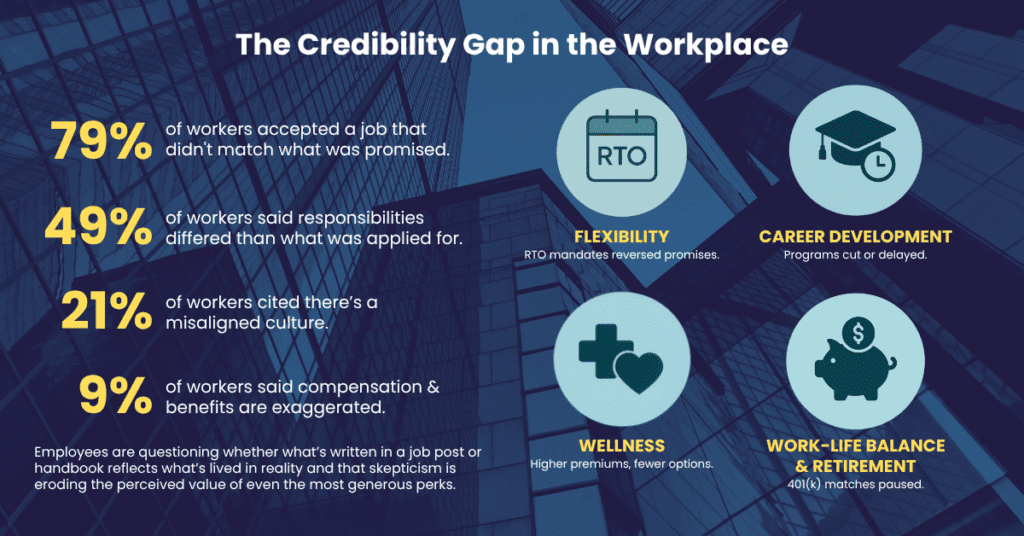
It’s a more common experience than many realize. Recent workforce data shows that nearly eight in ten employees have accepted a job that didn’t match what was promised. Almost half said their day-to-day responsibilities were different than advertised, 21 % reported that company culture didn’t align with expectations, and 9 % said compensation or benefits were exaggerated.
This mismatch carries real costs. The average cost per hire now exceeds $4,700, and replacing a poor hire can reach up to twice an employee’s annual salary. When job expectations are misrepresented, whether intentionally or through poor communication, trust erodes, morale declines, and turnover accelerates.
The Benefit of the Doubt
Companies are paying more to maintain benefits, yet many employees are beginning to question their value. Here are some of the most sought-after non-monetary benefits and what’s causing employees to lose confidence in them:
- Flexibility: While 68% of employers now rank flexible work as “very or extremely important,” ongoing return-to-office mandates are eroding confidence. Earlier this year, Uber required previously remote employees to return to the office three days a week and raised the eligibility period for its paid sabbatical program from five to eight years. The policy reversal sparked internal backlash — a reminder that flexibility only builds trust when it’s stable and consistently applied.
What could’ve been: A phased or voluntary transition, paired with transparent reasoning and manager-level autonomy, could have preserved both flexibility and credibility.
- Career Development: About 65% of employers prioritize career-growth and training programs, yet employees frequently see these fade under tight budgets or shifting priorities. When Amazon scaled back several inclusion and development initiatives in early 2025, employees who viewed those as advancement pathways felt misled. Growth loses meaning when programs are restructured or quietly deprioritized.
What could’ve been: Even modest programs can maintain trust when companies communicate continuity plans and celebrate internal progress, proving growth is still possible.
- Wellness & Recognition: Health benefits remain one of the most valued and closely watched parts of any employment package. Yet costs continue to climb, with Kansas City workers expected to face higher health-insurance premiums again in 2026. Some companies have shifted to high-deductible plans or limited coverage to manage expenses, leaving employees to shoulder more out-of-pocket costs. When “wellness” equates to higher bills, the perception of care fades quickly.
What could’ve been: Offering side-by-side plan comparisons, supplemental stipends, or preventive-care incentives could have turned a cost shift into a partnership, not a penalty.
- Work-Life Balance & Retirement: Even as 81% of employers emphasize leave and retirement benefits, some have scaled back major programs. In September 2025, Sherwin-Williams suspended its 401(k) match— a benefit many employees considered a stable part of their long-term financial wellbeing. When something as fundamental as retirement support becomes uncertain, it sends a message that other benefits, from PTO to flexibility, might be just as temporary.
What could’ve been: Communicating a clear reinstatement timeline or partial employer match would have signaled shared responsibility instead of retreat.
The Real Cost of Benefits
Belief is fragile and once it’s broken, no policy, perk, or paycheck can easily restore it. The emotional connection that keeps people engaged—pride, trust, and belonging—begins to erode. Employees can forgive limitations, but not inconsistency. And when credibility is gone, retention becomes a revolving door powered by skepticism rather than loyalty.
The irony is that most companies already invest heavily in the right things such as compensation reviews, benefits benchmarking, engagement programs but lose traction because the delivery doesn’t match the intent. The message is there; the meaning gets lost in execution. The challenge for employers is not about adding more to the package but proving what already exists. When employees see follow-through in small, everyday actions, benefits become believable again.
Credibility, then, becomes the multiplier of every investment in people. It turns pay into purpose, benefits into belief, and policies into culture. Without it, everything else is just numbers. Fair pay may open the door, but credibility is what keeps people inside. Because in the end, the true cost of benefit isn’t measured in dollars but in credibility.
Like what you're reading?
Subscribe today for insightful posts delivered via email. We respect your privacy and won't spam your inbox.